Author Archives | marc

Casa FOA: Interior Design for a Good Cause

Casa FOA: Interior Design for a Good Cause

Casa Foa

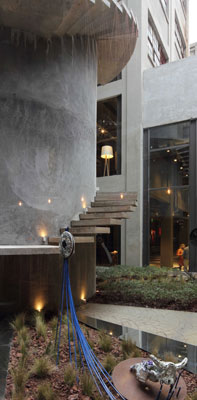
From the street, the imposing ex-Alpargata factory looks rustic and in sync with the other old and somewhat tired-looking buildings of Avenida Regimiento de Patricios. However, through the large doorway is an innovative space that is worlds away from the hustle and bustle of the streets of La Boca.

This is Molina Ciudad, the home of the 29th annual Casa FOA exhibition. It is here that architects, interior designers and landscapers each year transform a building that is falling into disrepair into a beautiful cultural and artistic space, showcasing the latest interior trends to the general public.

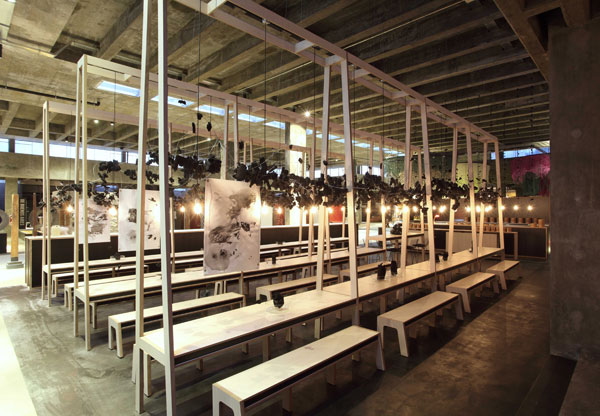
Molina Ciudad was named after artist Florencio Molina Campos, whose work focused on Argentine history and tradition with the pampa and its gauchos. Indeed, the building itself is located in a historically industrial neighbourhood with a rich and diverse multicultural history. The project contains hints of this past, with the lower floor dedicated to displays of modern art and design with an industrial twist. There is a collection of benches made from metal and wood creatively carved and welded into abstract shapes, and a tree trunk divided into lengthways strips.

It is up the brightly coloured stairs, however, where Casa FOA’s real purpose shines through. Red arrows guide you through an exhibition of expertly assembled rooms, from kitchens to bathrooms to children’s bedrooms, all demonstrating cutting-edge interior design.

Styles range from extremely modern and minimalist kitchens and bedrooms to ‘the library’, a cosy and rustic-feeling room with leather sofas, and themed rooms, such as ‘man’s bedroom’ and ‘chef’s kitchen’. While inspirational, the exhibits are also works of modern art, with quirky features including a table covered with eggs and a pile of bags sprouting herbs.

The crowd at Casa FOA is mainly composed of hip thirty-somethings, with a mixture of those looking for inspiration for their own homes and some who are genuinely interested in interior and graphic design. One visitor said, “I come to Casa FOA every year because I run an interior design company and I often meet others here who are doing the same as me. The different rooms and styles give me lots of ideas for new projects.”

In addition to this type of clientele, there are a couple of students scattered around the exhibitions taking photos and making notes. The project has had some collaboration with the Universities of Morón, Palermo and Belgrano, with students of architecture exhibiting their talents in a small display.

Art on display at Casa Foa

For those who are interested in bringing some of the vibe of Casa FOA to their own homes, contact details and representatives of the companies and designers are available in each section. There is also a selection of small shops selling arty bags and books.

The Casa FOA project, however, does not focus only on art and design. Proceeds go towards the Fundación Oftalmológica Argentina, a charity formed in 1989 that promotes research and teaching in the field of ophthalmology. The foundation also works with the community, funding eye surgery in areas of Argentina where access to medical treatment is restricted. This year, the Casa FOA project focused this campaign on the province of Tucumán, a mountainous region where geographic conditions make reaching medical services particularly difficult for some.

The overall impression that Casa FOA leaves is positive; the transformation of a building which would otherwise have been derelict into a useful and creative space is perfectly-executed, so that even the most inexperienced in interior décor could appreciate the beautifully-designed rooms and quirky modern art that the project has to offer. As a person of little to no experience in the field of furnishing a house past sticking up photos and posters, I found the exhibition and the pieces of art fascinating. Leaving Molina Ciudad and stepping back into the hectic, disorganised world outside, you come away with a sense of peace and tranquillity, as well as (if it’s your thing) the obvious multitude of new ideas to help transform your home into a stylish abode.

Ciudad Molina, Av. Regimiento de Patricios 1052, La Boca. Entry costs $60. Open Monday, Wednesday, Thursday and Saturday. Runs from 7th September – 14th October. For more information, see www.casafoa.com.

Posted in Art, The City0 Comments

Paraguay: Landless Farmers Announce Occupation Protest

Groups of landless farmers, known locally as ‘carperos‘, yesterday declared that they would begin to occupy territory in protest at government delays in allocating land. The protesters said they would begin to occupy land in eight days if they did not receive an official answer by then.

“If the government does not meet its commitment to intervene [in the land dispute], we will once again move on to the land and resist any attempt to remove us,” declared the group, according to TeleSurTV.

In the central department of San Pedro, the farmers threatened to take over 4,500 hectares of privately-owned land. Thousands of carperos in Ñacunday, in the South East of the country, also pledged to begin occupying land.

The dispute between rural landowners and peasant groups has been a major source of political tension in Paraguay this year. In June, clashes between police and carperos left 17 dead and were the trigger for the rushed impeachment of then president, Fernando Lugo.

Yesterday’s declarations came the same day as around 1,000 protesters from the National Peasant Federation (FNC) blocked a main road in protest at the arrival of genetically modified (GM) cotton seeds. Rural groups have heavily criticised the government of Federico Franco for approving the use of GM seeds in the country.

Posted in News From Latin America, Round Ups Latin America0 Comments

Relearning to Listen With Hugo Zuccarelli

Relearning to Listen With Hugo Zuccarelli

“What if I tell you that all the recorded and live music that you have heard through speakers your whole life was a lie?”

Well, you can’t be sure unless you experience it for yourself. This is how Hugo Zuccarelli challenges us at the start of his presentation in the “Teatro Ciego” (Blind Theatre) in Abasto, as he combines two interesting ideas to make a unique audio-sensory experience.

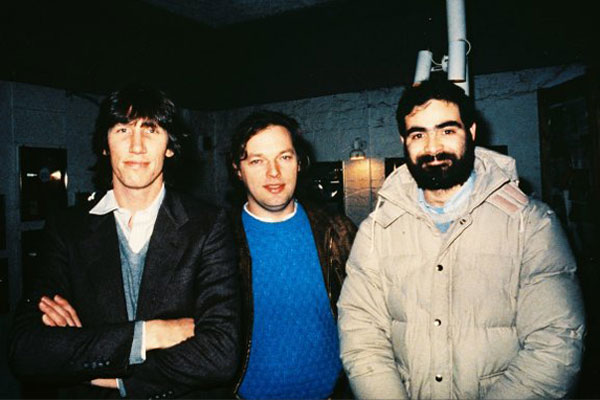
Roger Waters, David Gilmour and Hugo Zuccarelli in the 1970s (photo courtesy of Hugo Zuccarelli)

Hugo Zuccarelli is an Argentine inventor who dedicated his whole life to understanding the complex human hearing mechanism. During his studies in Milan, Italy, he postulated that human hearing analyses sound in a holographic manner. Taking that idea, he invented the HolophonicTM speakers, which provide the audio equivalent of 3D.

His speakers have four interesting characteristics: one source (instead of a sub-woofer, mid-range and tweeter as with regular speakers), a very low level of distorsion, the ability to hear music at a very high volume without damaging your ears, and lastly, for its three-dimensionality and unique wavelength, which apparently means the old lady downstairs won’t be disturbed when you are listening to good quality music at 3am.

After this discovering, Zuccarelli flew in the 80’s to England where he started an outstanding career recording as sound engineer with the likes of Pink Floyd, (on ‘The Final Cut’ album), Lionel Richie, Stewie Wonder, and Michael Jackson. However, his invention didn’t turn so well at a commercial level; none of the companies would accept these speakers in the production chain. Why? Well, that’s what I keep asking after listening to the amazing sound they produce.

Fortunately, in Buenos Aires, you can experience the holophonics at the “Teatro Ciego” which is a theatre operated in total darkness. And I’m not talking about shadows that you can distinguish after a few minutes when your iris adjusts: this is even darker than closing your eyes.

Getting into a pitch black theatre space is part of the fun. We set up in lines of six, each with the hand on the shoulder of the person in front, and entered to room in total darkness. Nobody could see anything and I was not able to imagine the dimensions of the place. It was like being in an odd dream.

In the darkness the only thing that you can do is listen. After we seated, Zuccarelli’s voice appeared once again presenting “Pink Floyd -The Wall”. Then silence, footsteps, a discman player opening, the disc going in, starting to run, and then I was listening to ‘In the Flesh’ for what felt like the first time. Even several days later, it’s really hard for me to describe that experience in words. In the darkness, the music is somehow painted in the air, like sound holograms.

Light in the darkness by Beatrice Murch

If you pay enough attention and you know the album you will hear things you have never listened to. Track after track I thought I knew, but something new appeared over and over again. The drums of Nick Mason, the voice and the choirs added by Roger Waters, and the guitars of David Gilmour with riffs I had no idea even existed.

When the second disc was finished I was so thrilled I wanted to hear it again, even though at this point it was around 1.30am (if you have to get up early in the morning you might want to reconsider this).

Zuccarelli returned and announced that the lights will come on little by little. Finally, I could see the room, which was completely different from what I imagined during the session. Zuccarelli appears in front of us and asks if we liked the performance. You can tell that he is a really passionate person and he tell us about the story of the Holophonic Speakers, of how he invented them back in the 80’s and why everyone should use them (he needs to sell his product and I’m totally behind that!).

The night ended an hour later: Zuccarelli demonstrated some ‘sound experiments’ in a strange and funny way and concluded with two more songs by Pink Floyd, including ‘Alan’s psychedelic breakfast’. This is a totally new experience for all senses at a really low cost; one that you will never forget.

Posted in Music0 Comments

Project of the Week: Latinoamerica Te Amo

IdeaMe is an online platform, which helps creators, be they inventors, artists, or designers, among others, to finance their projects through crowd funding. Each week, the Indy features and promotes one project every week, with the aim of helping the creators finance and achieve their dreams. This week: Latinoamerica Te Amo.

“Not only does the world scarcely know who the Latin American man is, the world has barely cared.” US journalist Georgie Anne Geyers may have written this in 1970, but almost half a century on, the sentiment remains one of the key inspirations for a new independent documentary project called ‘Latinoamerica Te Amo’.

Fed up with the trials and tribulations of the corporate television and film industry, four young filmmaking enthusiasts quit their prestigious jobs at Argentine television channels and set up their own independent film company Como Se Llama Cine. Their latest project, ‘Latinoamerica Te Amo’, will document a road trip they are undertaking throughout Latin America. The journey began in Rosario, Argentina on 5th September and will end in Mexico.

If all goes to plan, an old battered black van will be their home for the next two years. The vehicle has five passengers; the four filmmakers,Agustin Lagos, Luis Piccinali, German Oural y Maria Fernandez,and a mechanic, ‘Chicharito’, to ensure the mobile home stays mobile.

Their aims are simple: to prove that quality audiovisual content can be created without corporate or governmental funding, to voice the stories of people who otherwise may not be heard, and to unify Latin America through their work.

“We don’t want to earn money, we want to tell stories,” explains the group’s promotional video. Their footage takes the form of short documentary episodes, video diary entries and clips which are posted online at regular intervals during their journey. In an interview with Cordoba’s La Voz, one of the filmmakers said, “the idea is to experiment with classic documentary, interviews and fictional documentary”. The first three entries in their video diary are already available on Youtube and provide examples of the unique characters and inevitable car-related logistical issues that the group will come across along the way.

“We want to hear and tell the stories of all our brother countries”, the groups explains on their blog. In a region so often plagued by conflict, a documentary like ‘Latinoamerica Te Amo’ seeks to explore the common roots and appreciate the differences of its people and towns and seems like an excellent concept.

“Latin America is huge and our desire to cross it is too” reads the group’s facebook slogan. However, a trip of this nature is impossible without money, and the collective are appealing to the public for donations. “We need help from anyone who is able and interested” says Maria, the sole female member of the group. For the project to be a successful one and remain independent, we at the Indy encourage anyone who can to support ‘Latinoamerica te Amo’. Even if it is just to offer them somewhere to park their van along the way! Visit their Ideame page to learn more.

Posted in Film0 Comments

Top 5 Coworking Spaces

Top 5 Coworking Spaces

An expat translator fed up with the shortage of available outlets, fickle Wi-Fi connection, and endless rotation of coffee dates at her local café. A programmer struggling to maintain a productive work/life balance while freelancing from his living room. An entrepreneur dreading outfitting an office along with the rest of her new business. Unlikely though it may seem, each of these independent workers are likely to find a solution to their problems under the same roof.

Co-working spaces provide a great 'office' for freelance and virtual workers. (Photo courtesy of Urban Station)

Coworking combines the flexibility and independence of working from home with the professionalism and social outlets of a traditional office. More than just a middle ground, the combination also connects those who would otherwise work alone with new partners, clients, and friends.

A number of changes in professional work culture may account for the emergence of coworking. Technology’s impact on communication has levelled the limits of long-distance business relationships; working remotely is now much easier than before. One coworking business owner speculated that self-employment might be particularly attractive to Argentines because many lack faith in corporate stability after recent economic hardships. If large businesses no longer offer the same level of financial security—or are perceived as such- then more Argentines would turn to self-employment.

For whatever reason, coworking in Argentina is on the rise. According to a recent article by La Nación, the first coworking space in the country opened in Buenos Aires in 2007. In only five years, these spaces have flourished throughout the capital and spread across the country. Young people, foreigners, and members of the technology and creative industries are well represented among users.

Companies commonly offer the basics: desks and chairs, wireless internet, phones, printing, conference rooms, and kitchen items sufficient to heat up lunch. Usage plans, however, vary greatly from an hourly drop-in rate to annual contracts with many other configurations falling in the middle. (Given the range of options, please consult directly for specific plans and prices.) Facilities, location, community, size, and concept likewise run the gambit, so to help narrow down the options, here are the Indy’s top picks.

Urban Station provides a warm and inviting work environment. (Photo courtesy of Urban Station)

1. Urban Station

If in your opinion, the only thing wrong with the café around the corner its the erratic Wi-Fi connection, then Urban Station is for you. Its cosy, informal vibe is as close to a coffee shop as they come, while flexible drop-in plans and playful ambience make working feel less like a chore.

Urban Station’s Community Room is the grown-up version of your college library. Groups hunch over a single screen, conversing quietly, while clusters of laptop users work plugged into their headphones. Receptionists attend from behind a coffee bar. Like the clientele, the décor is upbeat and youthful, with bulletin boards full of business cards, secondary school-style lockers, and plenty of bright colours. Armchairs and communal tables enjoy abundant natural light beneath a two-story ceiling.

While quiet, it’s certainly busy enough to make taking a Skype call acceptable. Unlike our other picks, Urban Station plays unobtrusive music softly in the background. The second floor converts easily into an event space used for standard presentations as well as casting calls for models and actors.

Urban Station makes play as well as productivity a priority. The Palermo Soho location offers bikes for quick jaunts about the neighbourhood, while a San Telmo location, opening in mid-October, will offer a recreation room and a deck for cocktail parties and happy hours.

One unique upside of Urban Station is its flexible usage plans: dropping in and paying per hour is an option and plans can be used at any of their two (soon to be three) branches.

Urban Station has locations in Palermo and Microcentro, with a San Telmo office coming soon.

2. Céspedes Coworking

Doodled across the chalkboard in the Céspedes Coworking kitchen is the reminder, “Don’t stop playing.” Wise words for this small, artistic community committed to mutual respect and collective inspiration.

Céspedes offices. (Photo courtesy of Céspedes)

Céspedes calls home to a loft unit in a renovated Colegiales factory. The layout is open, aside from a single conference room, and small, with desk space for only 14. Although blonde wood tones dominate, touches like exposed brick and floor-to-ceiling graphite wall art give the space a creative feel. Expansive windows admit soft morning light from the east and provide impressive sunset views to the west.

Of the community, founder Paul Iribarne admits “an inclination towards the creative areas” and mentions architects, writers, graphic designers, filmmakers, translators, and journalists among the company’s typical clientele. Although all professions are welcome, compatibility is key (dependency upon frequent telephone use or visitors, for example, is vetted). For those whose projects dictate a schedule beyond the nine-to-five, 24-hour access is available.

Possibly the most distinct feature of Céspedes is its size. With room for only 14 and a minimum commitment of one month, coworkers are bound to get to know each other. They host asados, language conversation classes, cooking lessons and film viewings, often inspired and facilitated by the members themselves. “People feel very much a part of the place,” says Iribarne, “like they belong to something.”

For more information on Céspedes, click here.

Areatres workspace in Palermo. (Photo courtesy of Areatres)

3. Areatres workplace

Crisp white with green accents. Touches of brushed aluminium. Small potted bamboo shoots. Areatres’ clean look hints at how hassle-free working here is. Spatial options vary from the unusually small to the unusually large, yet no matter the scale, the fine points are in place. Areatres’ meticulous attention to detail allows you to get back to… well, work.

Areatres’ spaces include several unique options. From “1.5-person desks”, which offer four walls and a desk large enough for a single person and a perching visitor, to a presentation room large enough to accommodate up to 120 people, it has the market locked on scale. A private office suite offers common desk space, several small conference rooms, and a private kitchen and bathroom. This ‘office within an office’ gives larger companies all the perks of their own facility without any of the logistical hassle.

Areatres prioritises attention to detail and high-quality service, offering tech support, translation services, or event catering as requested, “We’re kind of a combination between a front desk and a concierge,” says Guillermina Providenti, Areatres Community Manager.

The company stands out for its interest in environmental sustainability and community involvement. Thoughtful details like rainwater use, worm composting, and battery recycling demonstrate an eco-friendly mentality. Areatres has been known to offer use of its spaces to local non-profit organisations and its kitchens collect donations for causes such as a local hospital and animal rescue.

Community building efforts that started with “Sushi Fridays” have now developed into regular picnics, soccer games, happy hours and other activities designed to bring people together away from their laptops.

Areatres have offices in Palermo Viejo and Palermo Hollywood.

4. The Office

If the name conjures images of Ricky Gervais or Michael Scott, forget it. Palermo’s The Office is anything but antics.

The Office work stations. (Photo courtesy of The Office)

Sophisticated black and beige is the hallmark of The Office’s sleek design. Rows of 46 individual desks extend to the back of the room, with skylights spilling prized sunshine down on the coworkers. Unlike other coworking companies, whose spaces bear greater resemblance to dining tables than cubicles, desks are divided to provide more personal space.

But what really distinguishes The Office from its counterparts is its upscale, traditional style. From the understated entrance to the neutral décor, the facility seems to reference the classiest of corporate boardrooms, ideal for those wanting to impress clients. There is no communal kitchen, no community bulletin board, and no patio furniture. As such, the noise level is essentially non-existent and everything has a thoroughly down-to-business polish. The Office caters perfectly to those less keen on casual collaboration and who prefer to work in a classic office setting.

Membership at The Office also includes discounts at local restaurants, a Spanish school, and at all P Hotels, one of which is conveniently located next door. For those who conduct business internationally, The Office’s extra perks could facilitate travel logistics.

Less than a month old, The Office is a newcomer to Buenos Aires’ coworking landscape. Those who prefer a solitary work style, travel often, or work with high-end clients will welcome an option that embraces a new model while maintaining classic professionalism.

For more information on The Office, click here.

5. Workstation Microcentro

Workstation describes their typical client as a young Argentine working in the technology industry, perhaps as a developer, programmer, or entrepreneur. Maybe that’s why Workstation emits a somewhat Google-esque vibe: techy, energetic, social.

Outfitted exclusively in minimalist blue, yellow, green, and red against white, Workstation Microcentro's layout includes a balance between open space and private offices. (Photo courtesy of Workstation Microcentro)

Outfitted exclusively in minimalist blue, yellow, green, and red against white, the layout includes a balance between open space and private offices. A large cafeteria area encourages collaboration and social connection on an everyday basis. With no less than 14 private offices for 2-20 employees, Workstation is another great option for companies looking for starter office space.

For those located on the northern side of the city, Workstation allows you to use each of their centres equally (the other is located in Belgrano), making a schlep into the city centre less onerous.

From a brief tour through the Microcentro location, the number of conversations held in English is striking. Because it only opened last July, it is hard to say if the Anglophone trend will persist, but for now, Workstation Microcentro might be a good choice for English-speakers staying in the country temporarily or who prefer to avoid the challenge of a foreign language.

Workstation Microcentro will be hosting Freelancer Week 2012 from 25th-28th September in which the public is welcome to both work and attend workshops on elements on effective freelance work (given in Spanish) for free. To top it off, stick around until the end for gifts, promotions, and raffles.

Workstation have locations in Microcentro and Belgrano.

Posted in Expat, The City, Top 50 Comments

What do you think about the voting reform bill?

What do you think about the voting reform bill?

The national government is proposing a major change in the voting law potentially making voting optional for 16-18-year-olds and allowing foreigners with permanent residency to vote in national elections. Voting is currently mandatory for 18-70-year-olds.

The potential reform has sparked some controversy. While those in favor of the reform believe that this is a good step in spreading democracy and integrating the youth, those opposed believe this is simply part of a re-reelection plan for President Cristina Fernández de Kirchner. We hit the streets to find out what the public thinks about the proposed changes.

Photos by Cecilia Baron

Maria Pid Sein, 45, unemployed, Caballito

I think it is a bad idea to have 16-year-olds vote. It’s a disaster. At that age, they don’t know what they are going to do in life. Each year they get worse and worse. I think it is a terrible idea. I don’t know who would vote. And if they are able to vote it is because the government has a plan for who is going to win.


Tomás Schweistein, 29, technician, Almagro

From what I understand it is going to be optional, not mandatory. And it could be a good option because if they are interested in it, in politics, it could be good. If they are interested, they should be able to vote.


Fredy Mendez, 25, cashier, Paraguay

I think it is a good idea. Before, young people lived in fear, but now there is more democracy. Young people already have the right to drink and to marry. They already know, they are already more mature, and each one can make their own decisions. From my point of view, the majority of my coworkers are in favor of Cristina [Fernández de Kirchner]. They love her because she has implemented a lot of youth programs. The older people and people from a higher class are against the government because Cristina [sic] wants a more secure country for everyone, not just them.

Eduardo Seipel, 37, policeman, Caballito

It is difficult to say because of the culture surrounding kids today. There is a group capable of voting and another group completely incapable of voting. There are kids that are more advanced and capable. And others that paint the walls and want to break everything in the city. Before, the kids loved their country, but that doesn’t exist today. They say, “We are going to break everything!” With the conditions today, they shouldn’t be voting. Once they love their country again, love their neighborhood, then maybe. Right now, they shouldn’t have that power.

Beatriz Saramiento, 60, elderly assistant, Puerto Madryn

I have my doubts. I think that there are kids who are ready and other kids who are not. I believe that some are more mature and some aren’t. I can’t say what I want exactly, I have a lot of doubts. For the future of democracy, maybe, but I am not sure if it is good or bad. But there are people who are not prepared yet. In school, there are some that are focused and driven, and others who are not. There is a lot of insecurity surrounding the issue.
 

Aldana Vera, 18, student, Villa Bosch

For me, it is a huge mistake. The reality is that if a 16-year-old is mature enough to vote, they are also old enough to find a gun and murder someone, and they should go to jail for that. If you have the right to vote, you should also have the ability to go to jail. I don’t think they should pass the law.

Posted in Opinion1 Comment

Voting Reform: Triumph for Democracy or Political Opportunism?

A bill granting voting rights to 16- and 17-year-olds is being debated in congress this week, creating tensions between government and opposition. The proposal has been held up as a major step forward for democracy by some, while others see it as an opportunistic political manoeuvre designed to boost government support in next year’s legislative election.

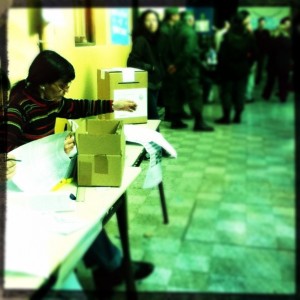
Voting in Argentina. (Photo: Caitlin Margaret Kelly)

The change in age restrictions would affect approximately 1.4 million young voters which represents 6% of the people that voted in the 2011 elections. Initially the bill included a clause under which foreigners that have lived legally in Argentina for over two years would also be granted voting rights. However, the government later announced that the issue would be addressed separately from the voting age debate and at a future date.

Senator for Buenos Aires, Aníbal Fernández, member of President Cristina Fernández de Kirchner’s Frente Para la Victoria party (FPV) presented the law before congress last week. “We have to give more rights to young people,” he announced and asked opponents “why are you afraid of youths?”.

Young Argentines and Politics

The concept of lowering the voting age has triggered a larger debate in Argentine society on the notion of political awareness among teenagers and what they could add to the political agenda.

Ines Canale, psychoanalyst and director of the Cooperative Amuyen Secondary School in Mar del Plata says: “I believe that this is a positive and logic step in integrating young people to the political culture of our society that is in accordance with the education reform implemented in 2004”.

The reform, put in place by the late President Néstor Kirchner, husband of President Fernández, included a number of modules designed to raise political awareness and responsibility in teenagers.

La Campora at a recent protest. (Photo: Patricio Murphy)

These include classes for 12 to 18-year-olds on Politics and Civism, Civism Construction, and Politics and Work. They are designed to encourage students’ sense of community and are articulated around projects created and managed by students as a group in what is an initiation to the mechanisms of modern democracy.

“In my school these new reforms have been extremely good, the students can choose what direction they want to take with their projects and have to compromise and discuss with their fellow students,” explains Canale.

Silvia Finnochio, a doctor in social sciences from the Latin American Faculty for Social Sciences, and professor in history at the Buenos Aires University who has written extensively on the place of young people and education in Argentine society, believes that young people are far from being “apathetic” as some opponents of the law have claimed. She said that they can bring a number of new elements to the public discourse and that they already have put forward new valuable perspectives on issues such as “memory and justice, the environment, and our consumerist society”.

A Question of Timing

In the current debate it is not so much the concept of extending voting rights to 16-year-olds, who can already be employed legally and are considered criminally responsible, that has been questioned by opponents of the government as the timing of the law proposal.

If the bill is approved, the new voting rights would first be used in next year’s legislative elections, in which the FPV will look to extend its dominance in congress.

Opponents of the bill see this, and not a desire to integrate the youth in politics, as the real reason behind the extension of voting rights. They point to a similar bill that was drafted by the Frente Amplio Progresista (FAP) in 2008 and was never properly considered by congress due to a lack of interest from the ruling party on the issue.

“It is a shame that such an interesting debate, that touches on what young people could bring to the political culture of our society is tainted by an inevitable sense of opportunism,” says Finnochio. In agreement is Doctor Adolfo Stubrin, from the Radical Party (UCR), head of planning at the Universidad del Litoral in Santa Fe and former president of the radical National Convention, who is “in favour of an extension of voting rights but as a part of a larger programme of inclusion and social integration”.

Optional or Compulsory?

Election Day in Buenos Aires (by Jorge Gobbi)

One of the key points of the debate between opposition and the ruling party has been the non-compulsory element of the law. According to the Argentine Constitution, voting is compulsory and sanctions exist for those who fail to do so. An exception is made for citizens over 70 years old who, although in theory are still obliged to vote, can no longer be punished for not doing so.

“The optional element of the law has been shown as an incoherence and as proof of the opportunistic and manipulative intentions behind the project. It’s like saying: we will give the rights to everyone, but the ruling party, that is able to mobilise more young women and men, will benefit more,” says Stubrin.

He also denounces “an irruption of political propaganda in secondary schools” in recent years in favour of President Fernández and her party.

These accusations were levelled last month at President Fernández after it was revealed that young activists from the pro-Kirchner youth organisation La Cámpora, led by Máximo Kirchner, the president’s son, had been holding workshops in secondary schools. The government defended these interventions as voluntary social programs designed to help the schools and Vice-President Boudou linked the opposition’s criticisms to propaganda during the 1970s in which the last military dictatorship tried to depoliticise young militants.

Constitutional Reform

Another recurrent criticism of the new law is that creating an exception by making voting optional for 16 and 17-year-olds would imply modifying, or at least bending, the constitution. This point has been raised and is particularly problematic in the eyes of political opponents of the president who fear she may try to reform the constitution to run in the next presidential elections.

“For this law to be possible you have to change the constitution and that worries me; we don’t want it to be the case that behind this move is a masked attempt for a reform that would allow the re-reelection of Cristina [Fernández de] Kirchner,” said Horacio Larreta the head of the Propuesta Republicana party (PRO) for the city of Buenos Aires.

President Fernández is currently serving her second consecutive term and is therefore forbidden by the constitution to run in the 2015 elections. She won the 2011 elections with an overwhelming majority but she is yet to designate a successor who could benefit directly from her popularity and no one obvious candidate is yet defined.

Whereas the PRO still has to announce its official position on whether to vote in favour or against the current bill, the FAP party, headed by Hermes Binner who came in second in the last presidential elections, has called to vote in favour.

However the FAP, and in particular it’s youth branch, have called for a number of amendments in the law. “Our position is that the vote should be compulsory for 16 to 18-year-olds, if not it would be discrimination against this age category and would be in clear contradiction with our constitution that says that suffrage should be ‘universal, equal, secret and compulsory’”, explained Maximiliano Diaz, head of the FAP’s Socialist Youth organisation.

Voting Rights in Latin America

Should the law be approved Argentina would not be an exception in Latin America as Brazil, Nicaragua, Ecuador and Cuba have all granted the right to vote to 16 and 17-year-olds.

Finocchio believes that in terms of granting more importance to young people in politics and society in general “it is very important that there is a balance in the region” and that “Brazil is a pioneer in this domain and has managed to do very innovative and interesting things that are unknown of, or ignored, in Argentina”.

In Brazil the constitutional reform implemented at the end of the last dictatorship in 1988 included the right to vote for 16 year-olds on an optional basis, while it is compulsory for citizens over 18. Policies of social inclusion in terms of gender, social class and youth have been banners of the two last presidencies.

The same voting rights apply in Ecuador and discussion on whether to implement similar measures are being held in Uruguay and Colombia and they were discussed and rejected in Venezuela. Nicaragua is the exception in the region as voting there is compulsory from age 16.

Argentina has followed the pattern of several of its neighbours in recent years in electing leaders running on platforms of equality and social inclusion, now it would seem that it wants to follow it’s biggest neighbour on the path of integrating younger people into its political culture. The consensus seems to be that lowering the voting age may be a step in the right direction but should serve as the first one on a longer path towards an extended democracy.

To find out what locals think about the voting reform, click here.

Posted in News From Argentina, TOP STORY1 Comment

La Historia en su Lugar: Theatrical Tours of Buenos Aires

La Historia en su Lugar: Theatrical Tours of Buenos Aires

How much do you know about Flores or Belgrano? Have you heard about the mysterious tragedy of the fiancés in Barracas? Have the cute tangueros of Balvanera sung for you on the hidden street Pasaje Discepolo?

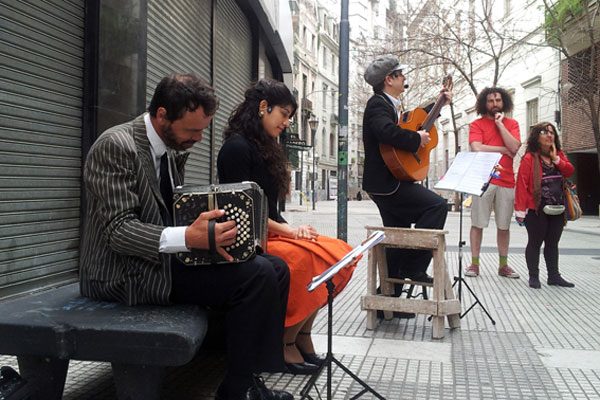
Theatrical performance on the street, accompanied by musicians. (Photo: Mariano Gambaccini)

For experienced travellers and expats, the tango/ wine/ meat in Palermo/ Recoleta/ Puerto Madero routine might not appeal anymore. Luckily, with its rich and extensive cultural development, the city of Buenos Aires has collected thousands of stories behind its massive doors and coloured windows. Practically each and every corner of the capital has memories to be shared and in many cases, it’s the lesser-known barrios that offer more interesting anecdotes than the tourist hubs. Surprisingly, a lot of porteños often also stand to learn more about their neighbours who may only live 20- 30 blocks from them.

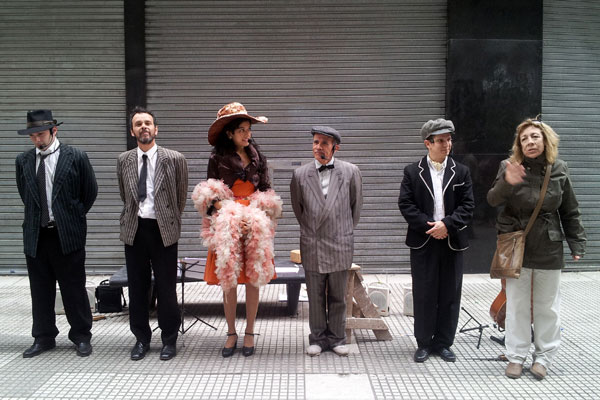
With that in mind, María del Carmen Sánchez, an artist and director, is offering a new activity called “La historia en su lugar” (The history in its place) for porteños and tourists in Buenos Aires alike. Supported by the city government, she invited two other artists, Marisé Monteiro and Ileana Ledesma in 2010, to join her in taking real history and wrapping it into short theatre plays. She also selected a group of actors and transformed them into unique city guides whose tours never include phrases like “look to the left, now turn to the right”. These guides have an extended role of a story-teller and a character at the same time.

Every tour proposed by “La historia en su lugar” is authentic and follows the same objective: to show the real history of the barrios through the characters that contributed to its creation. Del Carmen believes that in this way the participants perceive it in a more fun and personalised way. One programme, devoted to the writers of Avenida de Mayo,is consistently interrupted by the writers themselves. First we meet a charming Julio Cortázar who talks to us in a French accent, then we suddenly see Jorge Luis Borges running in La Casa de Cultura on his first day of work.

I felt like I was being sent to previous centuries as the characters were appearing out of nowhere and sharing their personal stories as if they had been talking to their friends of that epoch. An absolute absence of a stage and lights made the past history an actual reality, where everyone was observing the life of famous writers behind the curtains.

Meanwhile, “Los Inmigrantes de La Boca” gathers people in the heart of the barrio (which is not Caminito at all!). Famous for the port that received so many boats full of immigrants during the last two centuries, the community of La Boca was created by the funniest and the saddest stories. The workers and tango dancers of Balvanera sing traditional tangos involving the local people, who end up becoming the most important participants of the play. At times this show feels less like a tour and more like a typical evening soap opera, where all actors are passionate characters who hustle and laugh at the same time.

Having the play outdoors sometimes brings challenges, like adverse weather conditions and concerns over safety. Del Carmen Sánchez remembers that back in 2011 the theatre troupe was in need of security at Plaza Flores. The play called “Flores, barrio de poetas y leyendas” (“Flores, a Neighbourhood of Legends and Poets”) attracted not only the theatre lovers but also some drunk strangers who wanted to interrupt the tour. Luckily, nothing happened thanks to security and the artists could work safely.

When the plays finish, Del Carmen asks a crowd for the short evaluation. Alejandra, an elegant lady in her late 60s, shares that she didn´t miss any play in 2012. The programme, she said, enabled her to turn into a tourist in her proper city, and she claimed to have learned much more from the plays than history books. Other porteños on the tour add their own stories related to the barrios - a bonus for the curious foreigners.

Members of the theatre listen to a woman's opinions after the performance. (Photo: Mariano Gambaccini)

For next year, María del Carmen is planning to go into more barrios and look for more stories. “There is so much to say and show about the city of Buenos Aires,” she confirms.

All plays are free and in Spanish, and the average duration is 40-45 minutes and previous inscription is not required. The tours run during the weekends; they start in February every year and finish in October. Every tour except “Los inmigrantes de la Boca” is run once per month. Most plays start at 3.30pm. The barrios covered include Monserrat, Balvanera, Flores, Barracas, Boedo, Belrano, and La Boca. You can find more information about the project and the dates of every play on the website http://lahistoriaensulugar.com.ar

Posted in The City0 Comments

VIDEO: Vets in the Villas

VIDEO: Vets in the Villas

Fundaco is a foundation that sets up and operates animal clinics in the villas in and around Buenos Aires. Among the services they offer are free vaccinations and castrations for pets, performing as many as 80 procedures a day, while also educating locals about proper care for animals.

Camera & editing: Kristian Anderson

Posted in TOP STORY, Video, Villas1 Comment

A New Law and Order: Civil Code Reform in Argentina

Since 1871 Argentina has been governed by the same civil code, with only partial revisions. In 2012, 141 years later, Argentina is set to adopt a new civil code. One that, unlike the current one based on European law, will have ”an entirely South American vision.”

Congress is considering revising the codigo civil. (Photo: Beatrice Murch)

“This project is a paradigm change in our culture. Now we have the opportunity to have a code with a Latin American vision,” said the president of the Supreme Court, Ricardo Lorenzetti in a press statement.

When the draft bill was first presented on 27th March, President Cristina Fernández de Kirchner described it as “a qualitative leap.” Now, five months later, the Congress’ Bicameral Commission for the Updating and Unification of the Civil and Commercial Codes has 90 days to analyse the new draft code and issue a unified final version for voting.

The first round of debates began on 14th August as the group took a look at the reforms to marriage, divorce, and assisted fertilisation laws. A series of public hearings was held until 8th of September in Buenos Aires and will continue throughout September in other Argentine cities.

“This is establishing real equality, developing individual rights, raising a new concept of property, and strengthening legal certainty in our trade relations,” said Julio Alak, minister of justice and human rights, in the first public hearing.

Divorce

Under the new code both civil and commercial laws will be brought together to form one legislative document. However, the most significant changes will take place in family law.

“It’s a great initiative to focus on changes to family law, it’s a cultural revolution,” says Leticia Kabusacki, a lawyer who has practiced family law in Buenos Aires since 1988.

Divorce in Argentina is a bit more complicated than in the USA. (Photo: Robyn Lee)

The legislation governing divorce is to undergo the most significant changes and some of the most hotly debated. Currently the courts only grant divorce in two situations: when a couple has been separated for more than three years and both parties are willing to separate, or when a wrong has been committed against one of the parties in the marriage.

“There are certain grounds for divorce, like adultery, wilful abandonment, a serious injury, forcing your partner to commit a crime, and so on,” explains Kabusacki, “The problem is these people spend years in court trying to prove that one of these offences took place.”

Under the proposed new law the divorce system will become voluntary. If a spouse wishes to get a divorce they can simply go to court and file for one, without the need to explain why they wish to divorce or to prove that any offence has taken place.

The financial repercussions of divorce are also set to change. Currently the system requires everything gained during marriage to be split in half. However with the new law, couples can now come forward with their own plan to determine how their assets will be divided. “If there is a financial imbalance between the spouses there has to be compensation. That’s new and that’s important,” says Kabusacki.

Finally, the decision over the custody of children will also change, moving away from a bias towards the mother to providing an equal opportunity to be given custody. Today, the mother is typically given custody with broad visitation rights granted to the father.

It is one of the more contentious adjustments, and Kabusacki says this is the only change that worries her. “[The current system] reflects what most families do,” said Kabusacki, “I’m not sure if it is going to be a good idea to try and reflect ‘pure equality’ in the law.”

Civil Law Changes

Assisted fertilisation is another of the big topics gaining a lot of publicity as the commission looks to regulate a market that did not exist in 1871.

In vitro fertilization, the use of a sperm donor or a surrogate mother is practiced in Argentina but with no rules or laws governing it. This means the companies offering the services can charge whatever they want and if something goes wrong it is difficult to gain any legal grounds because there are no existing laws.

Leuprolide is drug women inject to control ovarian stimulation in In Vitro Fertilization (Photo: Beatrice Murch)

Leuprolide is drug women inject to control ovarian stimulation in In Vitro Fertilization (Photo: Beatrice Murch)

“We are currently under the worst scenario possible because assisted fertilisation, or anything besides the natural way and adoption, is not regulated,” says Kabusacki. “It’s very little what this new law is doing actually, we will still need more work after this, but it is a start.”

Although the laws in the new code will be very basic, they will lay the foundation for more changes that will have to be made in the future as technology continues to change and revolutionise the way humans reproduce.

“The legislature must be watching what is happening in science,” said Aída Kemelmajer de Carlucci, the former member of the Supreme Court of Mendoza. “Assisted reproduction has to have a specific regulation because it not only involves the genetic material of a couple but also that of a third party.”

Besides regulating the system, the new code will also seek to guarantee that the children conceived through assisted fertilisation are legally recognised by both parents, regardless of whose gametes were used. By ensuring this, the usual divorce laws will apply to a couple that separates, preventing one partner from potentially claiming they have no legal responsibility for the child ias their gametes were not used.

Significantly, the new code will uphold the current ruling that legally states a person’s existence starts with conception in the womb. For artificial fertilisation that means when the embryo is implanted in the women, making the collection of eggs and sperm legal because they are not considered ‘people’.

Other key changes regarding family law include a relaxation of adoption laws to permit unmarried couples, the ability of a child to take either parent’s last name, and stricter financial provision requirements for parents.

Common law couples living together for more than two years will officially be considered a union and will receive the same rights as a married couple. The economic relations between the partners will be registered in the form of a ‘pact’, under the common law registry.

Commercial Law Changes

While the civil law will hope to codify the interactions between people in a community, the commercial law, also known as business law, will apply to all commercial transactions.

One of the most substantial changes to the commercial law is the recognition of indigenous communal property. The aim is to preserve cultural identity and under the new legislation, registered indigenous communities will own land in rural areas, “for as long as those communities exist.”

“The use of natural resources will now require the consultation of indigenous communities,” said the minister of the Supreme Court, Elena Highton de Nolasco in a press conference. In this way, the law will protect indigenous communities from companies coming onto an area rich in natural resources and simply claiming the land, taking advantage of the flimsy legal standing of indigenous people. At a time when indigenous groups face serious problems from encroaching agriculture and mining, the new code will empower these communities to resist on clear legal grounds.

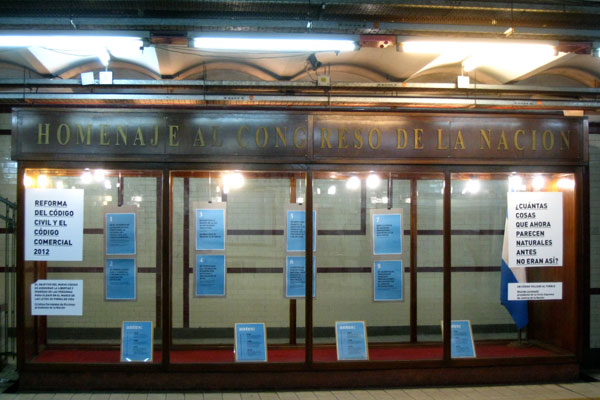
A display case in the Congreso subte stop explains some of the codigo civil. (Photo: Beatrice Murch)

Other adjustments in commercial law have been met with concern in the business community. A provision allowing changes to foreign currency contracts, for example, was added as restrictions on dollar purchases tightened, leading some to accuse the government of trying to ‘pesify’ the economy.

However, at the Commission meeting Lorenzetti attempted to clear any doubts, stating that the new law reflects a similar law in Brazil where contracts can be negotiated in foreign currency. “The debtor will shall have the possibility of freeing himself paying the equivalent in national currency,” he said. Lorenzetti added that it is reasonable because of the current global economy and used the convertibility law as an example of why the change is justifiable.

The new law will also govern electronic contracts, a contract made without the presence of both parties. The code will protect consumers who sign or accept a contract via email, Skype, or smart phone, thereby regulating the massive online market that is generally evolving too fast for the law to keep up with. In the future, say experts, new laws can be formed based upon how this basic standard performs.

The Opposition

Although the changes to the civil and commercial code are widely supported throughout the country, there are those who disagree, including the Catholic Church.

The Episcopal Conference of Argentina expressed their concerns in August, asking the commission to change the proposed new reforms in divorce, adoption, and assisted fertilisation.

“[These new reforms will create] marriages that are empty of content at the expense of the spouses and the good of the children, who have a right to grow up and be educated in a stable family,” said José María Arancedo, the head of the Episcopal Conference, at one of the Bicameral Commission meetings.

The conference argues that the new laws will fast track divorce and eliminate the values of marriage. They also argue that the new adoption laws will go against a child’s right to live in a family that consists of a married woman and man.

Arancedo also attacked the new code regarding surrogacy saying it will lead to the “rental of wombs,” and will create a situation that “degrades a pregnant woman.”

“It will be a source of further inequality because poor women will be exploited for this cause,” he said.

Finally, he argued against the reforms to assisted fertilisation in general claiming there are still severe ethical questions regarding the technology. “We need to recognise and grant legal protection to all human life from the moment of conception, and we need to remember that not everything that is scientifically possible is ethically acceptable,” he said.

Despite the church’s arguments, the president of the Supreme Court fully supports the revisions and says although there are some debates about the language being used, there is a general consensus amongst the members of the Bicameral Commission.

“It is a code that corresponds to the democratic language but is understandable for the common citizen. [The laws] are worth nothing if no one can understand them,” concluded Alak. “The new code will respond to the problems of reality today.”

Find out what locals think of the civil code reform here.

Posted in News From Argentina, TOP STORY2 Comments

Follow us on Twitter
Visit us on Facebook
View us on YouTube

In celebration of this week's Oktoberfest in Villa General Belgrano, we look back at Julian Stetter's beer-swilling visit to the provincial town in Córdoba.

    Directory Pick of the Week

Magdalena's Party in Palermo

Magdalena’s Party has daily 2 x 1 Happy Hour specials til midnight, and the "best onda".
Sign up to The Indy newsletter