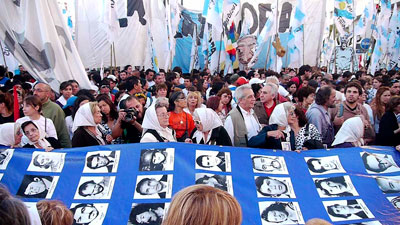
Abuelas remembering the disappeared on March 24, 2011 (Photo: Antonio Giron)
“In Argentina, not everybody knows who they are.” This is the way the Grandmothers of Plaza de Mayo, or the ‘Abuelas’, introduce their campaign to recover their grandchildren, los desaparecidos vivos, or the living disappeared, who went missing during the last dictatorship in what is now known as a systematic plan to steal children. From 1976 to 1983 an estimated 500 children were abducted along with their parents or born in captivity and then given away or sold to military families and their sympathizers. Out of those 500, 103 have ‘appeared’; this could mean either that the grandchild in question has been found and identified, or that there is evidence that the child was murdered along with his or her parents.
For thirty-four years now, the Grandmothers have quietly but persistently sought their grandchildren. They have withstood death threats, defied society’s disbelief, and disputed legal and judicial inertia; they have persisted through miles of red tape, pioneered technological innovations and scientific advances, and added to the sum total of knowledge regarding human rights. As a result of these tireless efforts, the Abuelas have been nominated this year, for the fourth year running, for the Nobel Peace Prize. But their path to fame has been everything but desirable.
Noble vs. Nobel
The Abuelas have been subjected to an uncommonly objectionable spotlight recently due to the high profile case of the Noble Herrera children, heirs to the Clarín Media Group fortune. However, what no media venue in Argentina seems to remember is that it was Ernestina Herrera de Noble herself who started the media hype surrounding her adopted children when in 2003 she wrote an open letter in the editorial page of Clarín where she declared she has spoken with her children about the “possibility that they are children of desaparecidos“. There can be no doubt that the ‘adoption’ of both Marcela and Felipe Noble Herrera is surrounded by questionable circumstances. According to Herrera de Noble’s declaration to Judge Ofelia Hejt in April 1976, she discovered ‘Marcela’ in a box on her doorstep and offered a neighbour and caretaker as witnesses. It was discovered in 2001, at age 85 the alleged caretaker, Roberto Antonio Garcia, declared before a tribunal that Herrera de Noble had never lived in the address given at the time, nor had the alleged neighbour lived there (later confirmed by the neighbour’s granddaughter and the police), and that he had never acted as her caretaker at any time.
In the case of ‘Felipe’, Herrera de Noble appeared before the same judge in July 1976 wanting to adopt another child; it just so happens that a single mother, Carmen Luisa Delta, also appeared at the same time wanting to give her ‘son’ up for adoption. It is to be supposed that all parties involved were able to settle matters satisfactorily, except for the gigantic odds against such an event really happening. In 2001, Judge Roberto Markovich was able to confirm that the number of Delta’s identity card belonged to a Hugo Talkowski and that ‘Carmen Luisa Delta’ never existed. Judge Hejt, now deceased, assumed her judge’s robes during the dictatorship and stepped down once the de facto government fell.
After a decade of fits and starts regarding whether or not the Noble Herrera children should comply with the law and submit to genetic testing, their data has finally been taken and recorded in the National Genetic Database, or BNDG. Notwithstanding the fact that thus far there has been no genetic match does not mean that the Noble children were not ‘appropriated’; the BNDG is by no means complete, meaning that not all the relatives of the disappeared have registered their DNA profiles there, and in some cases, all surviving family members of victims have themselves died. To date there are over 2,700 cases where no genetic matches have been found. The DNA of these individuals is kept in the database, nonetheless, for future scanning.
Despite claims from Clarín Media Group and the Noble de Herrera lawyers that the pair has suffered “persecutions causing irreparable damage”, the fact remains that the lack of compliance with the law shown since 2001 and the media frenzy surrounding the case falls at the door of the Noble clan and nowhere else. It is the public nature of Herrera de Noble’s occupation that has thrust this case into the spotlight and into the political arena, evidently to use whatever leverage, albeit one’s own ‘adopted’ children, to sling mud at the present administration. By converting Marcela and Felipe Noble Herrera into victims of an alleged political persecution, the Clarín Media Group mitigates and displaces “the horrifying crimes committed during the dictatorship and which are never dealt with by them in the public discussion of this case”.
The Myth of Argentina’s ‘Dirty Little War’
The significance of the illegal appropriation of children during the last dictatorship must be understood within the framework of the ‘Process of National Reorganisation’ the euphemism the military junta used to refer to their practise of silencing, abducting, and murdering any opposition to their ideas or government. Only five years have passed since the revoking of the ‘Indulto’ or ‘Reprieve’ which pardoned all repressors who acted during the dictatorship from any wrongdoing. During this time, the lawyers for the members of the military junta and other repressors have consistently offered up this line of defence, in the words of Florencio Varela, for the defence: “Here there was an Armed Force that acted according to a line of command; no one acted according to whim…this was a war and war is horrible. The mistake I see is that you want to judge acts of war according to the rights of peacetime. Those 500 children are like the 30, 000 desaparecidos (missing); that’s all make-believe.” To which federal judge Carlos Rozanski famously replied (2006): “all these are crimes committed against humanity within the Argentine Republic…this is genocide.”
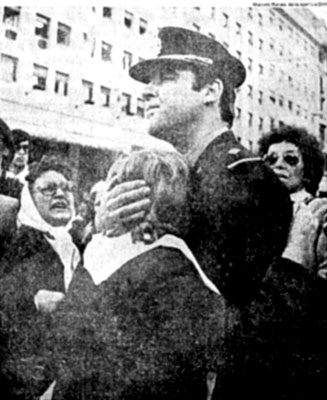
Pure Cynicism: Gallone with the mothers of Plaza de Mayo 1982 – (source wikimedia)
During the dictatorship, the de facto government considered that the subversive elements in the society that had to be eliminated were contagious; that is, that ideologies had to be stamped out by ‘disciplining and bringing subversive sectors of society under control’ as well as relocating the children of said subversives to ‘right-minded’ families, so that they would not ‘feel nor think’ like their parents. Adolfo Casabal Elias, defence lawyer for Miguel Etchecolatz (one of the most brutal repressors to ever come to trial in recent years) made this public declaration regarding the ‘re-location’ of children during the dictatorship: “In reality there was no plan to kidnap children; on the contrary, what the Armed Forces were trying to do was place the guerrilla children in good hands.”
One of the most devastating weapons of military repression applied to Argentine society during this time period was to keep people isolated, in order to make sure that there were no grass-roots efforts at unification at any level, because, of course, “in unity there is strength”. Common propaganda slogans would affirm: “Silence is health” or “Do you know where your child is?” In this way a family would be stigmatized if any member were detained, abducted, or ‘disappeared’, and others would stay away from them for fear or ignorance. But eventually, the despair and fear that accompanies a parent with a missing child drove many affected mothers to knock on doors – offices of lawmakers, hospitals, churches, etcetera – looking for their children and/or information as to their whereabouts. The ‘Mothers of Plaza de Mayo’, or ‘Madres‘, was formed initially from women who would constantly bump into one another in the waiting rooms of these different bureaucratic offices and came to discover that they had a common goal: recovery of their missing children alive, justice for the victims and their families, and punishment for those responsible. Their missing children were the tie that brought them together despite the efforts of the repressors to alienate them.
In June 1977, after six months of Thursdays walking the Plaza de Mayo in front of the Casa Rosada to protest the silence of the de facto government regarding the fates of their missing children, one of the Madres asked: “Who else is not only looking for a missing child, but also a missing grandchild?” Eleven other women stood forth, and thus was born the organisation known today as the Abuelas. Over three decades have passed and nothing has weakened the passion of these women in their search for their grandchildren. Perhaps it is their conviction that their grandchildren survive, whereas it is doubtful nowadays that a desaparecido would be found living, which inspires them to continue their search to recover them.
Grandparentage Index
Thanks to the unflagging efforts of the Abuelas, a new method for identifying the genetic relationship between a grandparent and grandchild was developed. Argentine law requires that there be a scientific procedure capable of establishing a biological link between the subjects in question in order to prove identity. For this reason, the Abuelas contacted Dr. Fred Allen of the Blood Centre in New York, as well as Dr. Mary-Claire King and Dr. Cristian Orrego from the University of Berkeley who in response to the Abuelas’ plea, actually developed the method whereby said biological link can be established even after skipping a generation. The technique is called the ‘Indice de Abuelidad’, or Grandparentage Index, or in honour of the Abuelas de Plaza de Mayo, and is 99.9% reliable.
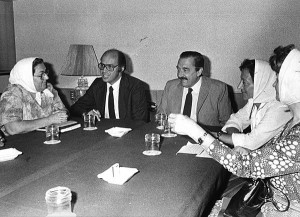
Alfonsín meeting with the Madres (source Wikimedia)
Once this technique was established, the Abuelas achieved an even greater goal. In February, 1986, three years after democracy had been established in Argentina, the Abuelas met with then-president Raúl Alfonsín and presented him with their concerns regarding the difficulties of establishing biological connections legally in the country. They suggested the creation of a National Genetic Database (or BNDG, by its initials in Spanish), whereby DNA samples of family members and children doubting their parentage could be obtained, stored, and compared. Now as the Abuelas are reaching an ever advancing age, their genetic data is safe in the BNDG so that those who have doubts about their real identity can compare their data even though the grandmother in question might no longer be alive.
The Argentine Clauses
The Abuelas were also key to the formation of the CONADI or National Commission for the Right to Identity. But what exactly is the right to Identity? While other rights, such as the right to life or free speech are easy to understand, the right to identity is not so obvious. It is, in short, the right of every person “to know who he or she is”. Because of the abuses of the dictatorship and ‘baby theft’ or illegal adoption practices, many young adults have no clue as to their true identity, their real families; many have even by now formed families of their own, and are raising their own children ignorant of their roots and history. In legal terms, those responsible for these crimes are guilty of ‘suppressing the identity’ of the children involved. So, 30 years after declaring the rights of the child, on 20th November 1989, the UN General Assembly adopted the Convention of the Rights of the Child, or UNCRC, including three clauses that make reference specifically to the Argentine experience regarding the illegal appropriation or ‘suppression of identity’ of children during the years of the de facto government. These clauses are known as the ‘Argentine clauses’:
Article 7 (Registration, name, nationality, care): All children have the right to a legally registered name, officially recognised by the government. Children have the right to a nationality (to belong to a country). Children also have the right to know and, as far as possible, to be cared for by their parents.
Article 8 (Preservation of identity): Children have the right to an identity – an official record of who they are. Governments should respect children’s right to a name, a nationality and family ties.
Article 11 (Kidnapping): Governments should take steps to stop children being taken out of their own country illegally. This article is particularly concerned with parental abductions. The Convention’s Optional Protocol on the sale of children, child prostitution and child pornography has a provision that concerns abduction for financial gain.
It must be remembered that the events in question are still painful in the minds of most Argentines; the past is far from being resolved, and the motto of the Grandmothers – Truth, Memory, Justice – is not yet fait accompli. Julio E. Nosiglia in his book, ‘War Booty’, quotes the words of Judge Marta Delia Pons directed towards one of the Abuelas: “Personally, I’m convinced that your children were terrorists. And for me, terrorism is synonymous with killer. I have no intention of returning a killer’s children to him. Because it wouldn’t be just to do so. Because he doesn’t know how to raise them and because he has no right to raise them…you will get custody of these children over my dead body.” The fact that these words are quoted from a judge, and a woman to boot, give some idea of how entrenched the political propaganda imparted by the civil and military authorities during the dictatorship was. However the appearance of legal respectability has finally begun to fall apart. Two weeks ago, Pons’ tribunal was closed, but the Abuelas’ legal team and a public prosecutor were able to ‘rescue’ over a thousand archives that will hopefully shed some light on the whereabouts of some of the missing grandchildren.
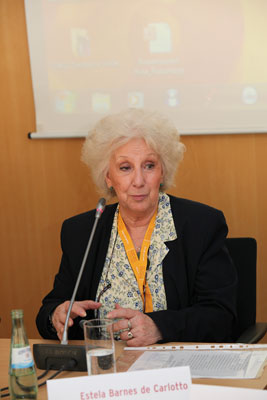
Estela Barnes de Carlotto (Photo: Deutsche Welle)
Additionally, a little over a month ago, the president of the Abuelas, Estela de Carlotto, while testifying yet again during a trial against a former perpetrator, formally requested that the government open the files of the Secretary for State Intelligence (SIDE), the sinister local version of the US’s Federal Bureau of Investigation. Again, it is hoped that historical transparency will give new leads as to the whereabouts of not just the grandchildren but of the remains of their parents, and the other desaparecidos.
The Better Part of Valour
During more than 30 years of searching, the Abuelas have never revealed the public or ‘appropriated’ identity of one of the recovered grandchildren, only the names given to them by their biological parents. The Noble Herrera case is neither the first case where judges have ordered genetic samples to be taken nor the first case where the grandchildren have resisted knowledge of their true identity. In fact, the discretion with which the Abuelas carry forth their tasks has ironically called worldwide attention to their activities. This will be the fourth year that the Abuelas have been nominated to receive the Nobel Peace Prize, though the women themselves, many of whom now are quite elderly, are not interested in prizes: “I’ll be happy when I know where my children and grandchildren are,” says Chichi Mariani, one of the co-founders of Abuelas.
If discretion is the better part of valour, the Abuelas de Plaza de Mayo have proven themselves to be examples of civic courage and perseverance. In their attempts to track down the members of their own families, they ended up forming a greater, extended bond with the other grandmothers and families, earning them an important place in modern Argentine society. When asked if their contribution to human rights and the return of democracy in Argentina is an example of grace under fire, one grandmother replied: “I’m no longer just looking for my grandson; I, along with the other grandmothers are engaged in this struggle, this great collective struggle and it’s something that has united us all…we all come from different social groups, but we came together because of our pain and our hope…because we do have much hope. But without the combined help of everybody, we would never have found our grandchildren.” As their website mission statement declares: “The history of the Abuelas is a chapter of hope in the history of Argentina because it proves that through collective effort it is possible to achieve our dreams.”
Abuelas de la Paz from Politegia on Vimeo.


