
In 2001, the words “Que se Vayan Todos” echoed around Argentina as anti-government protests spread amidst economic crisis. The phrase roughly translates as “Kick the lot of them out”. Such a brutally unforgiving attitude towards those in power stems from a long history of bad guys in Argentine politics.
Below, I have selected a few Argentines who are among the most vilified today. The fact that the list is entirely made up of men does not indicate sexism, but rather that it would appear, on the face of history at any rate, that we tend not to demonise the fairer sex to the same extent as we do men.
Let us join in our appreciation of these figures, these villains, without whom perhaps we would not have heroes. It is important to remember wrongdoing, in order to comprehend good. Churchill may never have been revered as he is if he hadn’t faced Hitler. Without the Joker, surely Batman is merely an oddly dressed adult male? We need our villains, and when it comes to Argentine political history, we are spoilt for choice.
In no particular order…
Carlos Menem
Carlos Saúl Menem, otherwise known as Carl Saul-less Menem. His name is an anagram of Narco Smell Mäuse (I added the umlaut, a necessary oversight in order to give the word its German significance - mouse). Anyone whose name is an anagram of a drug-selling odorous German mouse should surely not be trusted. Yet the hairy-cheeked politician was re-elected for a second term and enjoyed widespread popularity during the 90s as he led Argentina out of one economic crisis, but ultimately, into another.
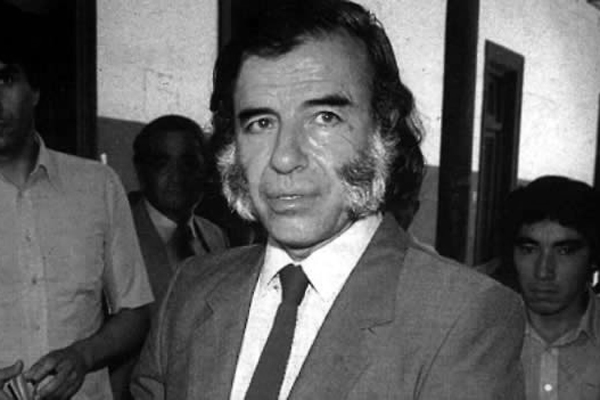
Carlos Menem
The Ferrari-loving Menem married a Miss Universe model and fathered a child at the age of 73. What’s villainous about that you say? Nothing, impressive work. However this does not compensate for the fact that he presided over a period of immense corruption, during which class division grew, and seeds were sewn for the 2001 crisis. President of Argentina from 1989 to 1999, his tenure is known as the “pizza and champagne” years. Hardly a villain-worthy title, but misleading, as in reality very few enjoyed Moet and mozzarella amidst the rubble of Argentina’s economy post-Menem’s quick-fix solutions. He also infamously reversed the policy of his predecessor Raúl Alfonsín and pardoned almost 300 military officers convicted of human rights violations during the Videla dictatorship. Nice.
As the flamboyant Menem’s sideburns shrunk, the reverse happened to government spending, which in total doubled during his time in power. With the peso tied to the dollar, the government had to borrow its way out of trouble, and foreign debt ballooned to US$142 billion. Menem privatised countless state-run companies to the benefit of very few and opened the door to foreign investors who drove small local businesses into the ground. As he departed from the Casa Rosada in 1999 in his Ferrari, he left with 40% of Argentines living below the poverty line and unemployment at 14%.
As a result of this, an amusing belief has rippled throughout the country that the German mouse is cursed. So much so, that people have been known to touch their left testicle or breast (or both) upon shaking Menem’s hand in order to dispel his demons. The former president is blamed for the slump in form of Gabriela Sabatini towards the end of her tennis career, which came after he played a friendly match with her. It is also rumoured that he is not allowed to attend the football matches of his beloved River Plate or Argentina’s national team for fear that he may have a damaging impact on the outcome. He has taken on a Voldemort-esque persona with some Argentines even refusing to refer to him by name, instead employing “Mendez” to be safe.
Julio Argentino Roca
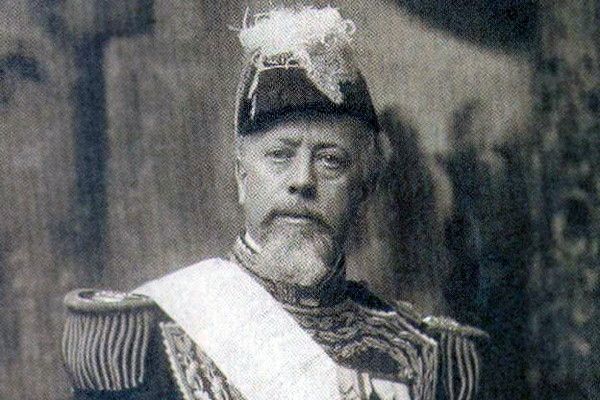
Julio Roca
Like many of the so-called villains on this list, Julio Argentino Roca wasn’t all bad. He is the man responsible for the creation of a civil registry in Argentina, made education free during his time in power, and oversaw a state-controlled economy which flourished. For almost a century after his presidential reigns in 1880-1886 and 1898-1904, Roca was heralded as a military hero and one of the founding fathers of the Argentine nation, having tamed the wild interior territories of the south. His face, to this day, still adorns $100 notes, although recently there have been campaigns to change this.
Why? Modern academic work has revealed nasty truths leading to a U-turn in public opinion on Roca, instead finding him to be guilty of a brutal genocide in the rural parts of Argentina. Roca is most famous for his ‘Conquest of the Desert’, a campaign that has consigned him to his fate as one of history’s worst bad guys. Once hailed as “uniting Argentina”, it has subsequently been revealed that the reality of the mission was to exterminate indigenous tribes. His armies succeeded in killing and displacing thousands of indigenous people. Native villages were pillaged and destroyed, and the local land was redistributed.
Certain avenues named after the general have subsequently been renamed and there are campaigns to topple his statues. Whilst Roca may have secured Patagonia as Argentine territory, and in doing so cemented the country’s future role as an agricultural super power, he also found time to kill and enslave thousands of Mapuche and other indigenous people.
Jorge Rafael Videla
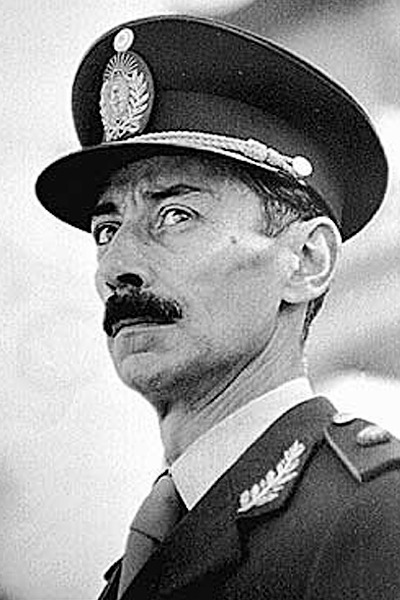
Jorge Videla
No top 5 Argentine Villains list would be complete without Jorge Rafael Videla, arguably Argentina’s best-known tyrant. A military coup in 1976 gave him power in Argentina, amidst a backdrop of political and social chaos, and for the next five years he presided over one of the most brutal military dictatorships seen in recent Latin American history.
“As many people as necessary must die in Argentina so that the country will again be safe”, Videla famously declared in 1975. He sought to purge Argentine society of all remotely liberal ideology. Initially Leftist guerrillas, Peronists, Montoneros and “subversives” were targeted. But soon human rights activists, journalists, students, relatives of revolutionaries, Jews, and countless other innocent people were also being rounded up in the unmarked Ford Falcon cars of the Buenos Aires military police or death squads. The details of what happened to people in the camps are horrific – reports of electric shock treatment, simulated drowning, and mock executions have all emerged. People were tortured, raped, executed, or disappeared. In some cases, their bodies were dumped out of planes into the sea. Elsewhere, they were burned and buried in mass graves – all under General Videla’s watch.
Videla was initially nicknamed Pantera Rosa (The Pink Panther) because of his slim build. Somehow it doesn’t seem entirely appropriate to compare a mass-murdering tyrant to a lanky, tip-toeing feline animation. Some media first described him as a political moderate who sought to bring an end to political terrorism, a dove amongst hawks who could purge the military of ruthless hardliners. Unfortunately, this did not turn out to be the case. Videla is currently serving a very lengthy sentence in an Argentine prison, which proves that justice can eventually be achieved, although suffering cannot be forgotten, and his actions will never be forgiven by many people.
Juan Manuel de Rosas
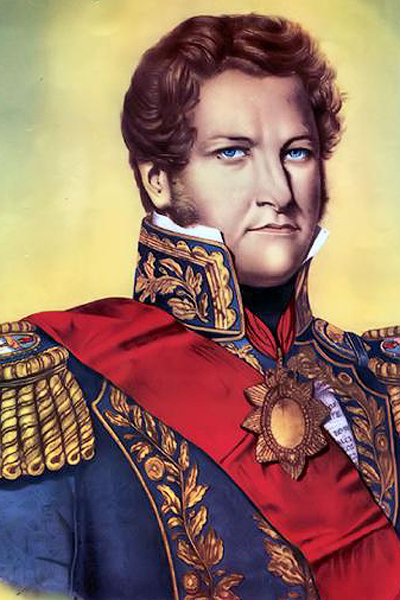
Juan Manuel de Rosas
“The Louis XI of Argentine History”. “The Machiavelli of the Pampas”. “The Caligula of the River Plate”. As the nicknames suggest, Juan Manuel de Rosas was a villain who ruled with an iron fist.
Rosas officially occupied the position of governor of Buenos Aires for all but three of the years between 1829 and 1852 but in reality he acted as a dictator of the entire country. He built a ruthless secret police force, shot those who rebelled against him without trial, and required citizens to wear his colours. He managed to consolidate his position by channeling the hatred of the masses for the class system to his benefit and maintained the support of the church. Rosas was a tyrant, but he was a very clever tyrant. Despite lots of pressure, he intelligently avoided introducing a federal constitution to the gaucho-run country, since he knew that Buenos Aires Province, where he governed, was the most powerful state, and that a federation would cause potential threat to that.
Various schools of revionist historians have argued that Rosas’ harsh rule was justified in the face of the anarchy and violence that was occurring at the time in the country. Just as Menem did, and Videla claimed he did, the historian John A. Crow writes that Rosas “had indeed saved the country from anarchy” but just as the others’ solutions came with a significant price, Rosas “had given [the country] chains”.
Yet who was it that presided over the return of Rosas’ bones to Argentina, and led a riverboat procession of the coffin throughout Argentina? Yep, you guessed it, our old furry-faced friend Carlos Menem.
Emilio Eduardo Massera
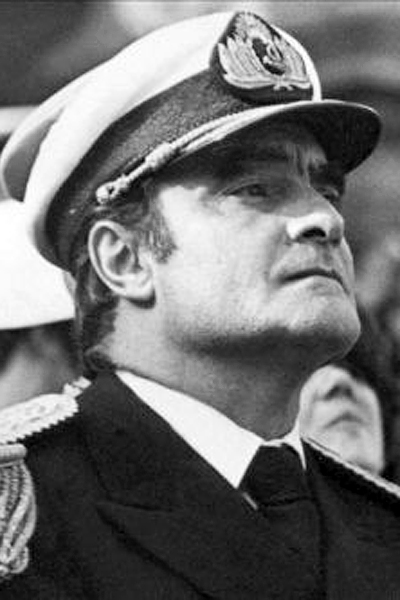
Emilio Massera
Nothing screams villain louder than a pair of thick, dark, bushy eyebrows. The furry black caterpillars above Emilo Massera’s eyes give the man a disarmingly evil visage.
Many believe Massera, a former admiral and instigator of the 1976 coup, to be the true mastermind and architect behind the military junta’s brutal repression of society. This was a campaign that sought to crush all political opponents of the military and restore stability to the country. Official figures state that it resulted in the death and disappearance of 13,000 people, but human rights organisations place the figure closer to 30,000.
Massera acted as Videla’s sidekick during the late 1970s; he oversaw the most violent years of the disctatorship and headed up the Naval Mechanical School, ESMA, which essentially doubled up as the country’s most prominent concentration camp.
Massera is also highly likely to be largely responsible for the stealing of more than 500 babies born to jailed dissidents. He sold the babies of the tortured prisoners, often victims of rape, to fellow military officials and supporters of the dictatorship.
In 1985, Massera was convicted of three murders, 12 torture charges, and a further 69 kidnappings. However, he never served the full sentence for these crimes, thanks to another member of this list (Menem again), who kindly pardoned him of his crimes against humanity in what he called a gesture of reconciliation. In 2002, when these amnesties were overturned, Massera was spared trial after a stroke left him too ill and senile to be prosecuted. He died of a heart attack aged 85, just two years ago.


Facebook comments