Tag Archive | "voting reform"

What do you think about the voting reform bill?


The national government is proposing a major change in the voting law potentially making voting optional for 16-18-year-olds and allowing foreigners with permanent residency to vote in national elections. Voting is currently mandatory for 18-70-year-olds.

The potential reform has sparked some controversy. While those in favor of the reform believe that this is a good step in spreading democracy and integrating the youth, those opposed believe this is simply part of a re-reelection plan for President Cristina Fernández de Kirchner. We hit the streets to find out what the public thinks about the proposed changes.

Photos by Cecilia Baron

Maria Pid Sein, 45, unemployed, Caballito

I think it is a bad idea to have 16-year-olds vote. It’s a disaster. At that age, they don’t know what they are going to do in life. Each year they get worse and worse. I think it is a terrible idea. I don’t know who would vote. And if they are able to vote it is because the government has a plan for who is going to win.


Tomás Schweistein, 29, technician, Almagro

From what I understand it is going to be optional, not mandatory. And it could be a good option because if they are interested in it, in politics, it could be good. If they are interested, they should be able to vote.


Fredy Mendez, 25, cashier, Paraguay

I think it is a good idea. Before, young people lived in fear, but now there is more democracy. Young people already have the right to drink and to marry. They already know, they are already more mature, and each one can make their own decisions. From my point of view, the majority of my coworkers are in favor of Cristina [Fernández de Kirchner]. They love her because she has implemented a lot of youth programs. The older people and people from a higher class are against the government because Cristina [sic] wants a more secure country for everyone, not just them.

Eduardo Seipel, 37, policeman, Caballito

It is difficult to say because of the culture surrounding kids today. There is a group capable of voting and another group completely incapable of voting. There are kids that are more advanced and capable. And others that paint the walls and want to break everything in the city. Before, the kids loved their country, but that doesn’t exist today. They say, “We are going to break everything!” With the conditions today, they shouldn’t be voting. Once they love their country again, love their neighborhood, then maybe. Right now, they shouldn’t have that power.

Beatriz Saramiento, 60, elderly assistant, Puerto Madryn

I have my doubts. I think that there are kids who are ready and other kids who are not. I believe that some are more mature and some aren’t. I can’t say what I want exactly, I have a lot of doubts. For the future of democracy, maybe, but I am not sure if it is good or bad. But there are people who are not prepared yet. In school, there are some that are focused and driven, and others who are not. There is a lot of insecurity surrounding the issue.
 

Aldana Vera, 18, student, Villa Bosch

For me, it is a huge mistake. The reality is that if a 16-year-old is mature enough to vote, they are also old enough to find a gun and murder someone, and they should go to jail for that. If you have the right to vote, you should also have the ability to go to jail. I don’t think they should pass the law.

Posted in OpinionComments (1)

Voting Reform: Triumph for Democracy or Political Opportunism?


A bill granting voting rights to 16- and 17-year-olds is being debated in congress this week, creating tensions between government and opposition. The proposal has been held up as a major step forward for democracy by some, while others see it as an opportunistic political manoeuvre designed to boost government support in next year’s legislative election.
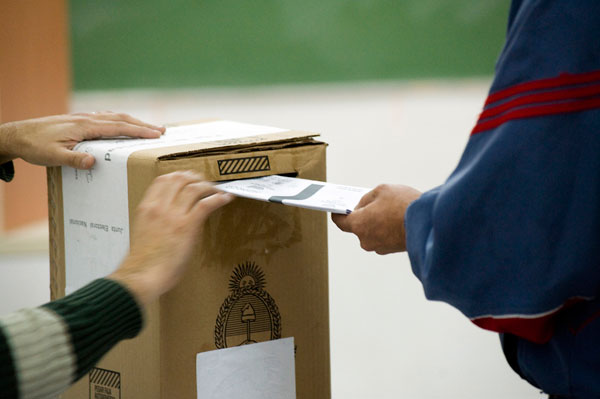
Voting in Argentina. (Photo: Caitlin Margaret Kelly)

The change in age restrictions would affect approximately 1.4 million young voters which represents 6% of the people that voted in the 2011 elections. Initially the bill included a clause under which foreigners that have lived legally in Argentina for over two years would also be granted voting rights. However, the government later announced that the issue would be addressed separately from the voting age debate and at a future date.

Senator for Buenos Aires, Aníbal Fernández, member of President Cristina Fernández de Kirchner’s Frente Para la Victoria party (FPV) presented the law before congress last week. “We have to give more rights to young people,” he announced and asked opponents “why are you afraid of youths?”.

Young Argentines and Politics

The concept of lowering the voting age has triggered a larger debate in Argentine society on the notion of political awareness among teenagers and what they could add to the political agenda.

Ines Canale, psychoanalyst and director of the Cooperative Amuyen Secondary School in Mar del Plata says: “I believe that this is a positive and logic step in integrating young people to the political culture of our society that is in accordance with the education reform implemented in 2004”.

The reform, put in place by the late President Néstor Kirchner, husband of President Fernández, included a number of modules designed to raise political awareness and responsibility in teenagers.
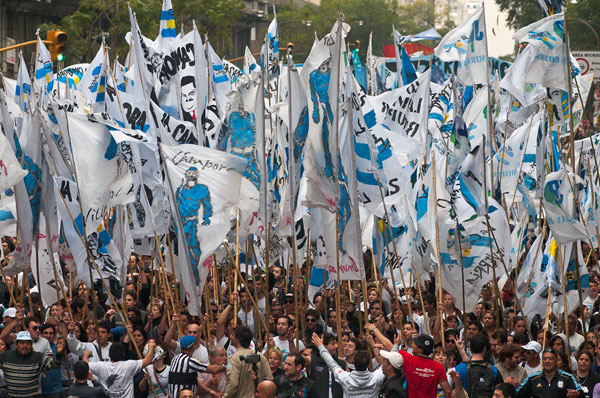
La Campora at a recent protest. (Photo: Patricio Murphy)

These include classes for 12 to 18-year-olds on Politics and Civism, Civism Construction, and Politics and Work. They are designed to encourage students’ sense of community and are articulated around projects created and managed by students as a group in what is an initiation to the mechanisms of modern democracy.

“In my school these new reforms have been extremely good, the students can choose what direction they want to take with their projects and have to compromise and discuss with their fellow students,” explains Canale.

Silvia Finnochio, a doctor in social sciences from the Latin American Faculty for Social Sciences, and professor in history at the Buenos Aires University who has written extensively on the place of young people and education in Argentine society, believes that young people are far from being “apathetic” as some opponents of the law have claimed. She said that they can bring a number of new elements to the public discourse and that they already have put forward new valuable perspectives on issues such as “memory and justice, the environment, and our consumerist society”.

A Question of Timing

In the current debate it is not so much the concept of extending voting rights to 16-year-olds, who can already be employed legally and are considered criminally responsible, that has been questioned by opponents of the government as the timing of the law proposal.

If the bill is approved, the new voting rights would first be used in next year’s legislative elections, in which the FPV will look to extend its dominance in congress.

Opponents of the bill see this, and not a desire to integrate the youth in politics, as the real reason behind the extension of voting rights. They point to a similar bill that was drafted by the Frente Amplio Progresista (FAP) in 2008 and was never properly considered by congress due to a lack of interest from the ruling party on the issue.

“It is a shame that such an interesting debate, that touches on what young people could bring to the political culture of our society is tainted by an inevitable sense of opportunism,” says Finnochio. In agreement is Doctor Adolfo Stubrin, from the Radical Party (UCR), head of planning at the Universidad del Litoral in Santa Fe and former president of the radical National Convention, who is “in favour of an extension of voting rights but as a part of a larger programme of inclusion and social integration”.

Optional or Compulsory?
Election Day in Buenos Aires (by Jorge Gobbi)

One of the key points of the debate between opposition and the ruling party has been the non-compulsory element of the law. According to the Argentine Constitution, voting is compulsory and sanctions exist for those who fail to do so. An exception is made for citizens over 70 years old who, although in theory are still obliged to vote, can no longer be punished for not doing so.

“The optional element of the law has been shown as an incoherence and as proof of the opportunistic and manipulative intentions behind the project. It’s like saying: we will give the rights to everyone, but the ruling party, that is able to mobilise more young women and men, will benefit more,” says Stubrin.

He also denounces “an irruption of political propaganda in secondary schools” in recent years in favour of President Fernández and her party.

These accusations were levelled last month at President Fernández after it was revealed that young activists from the pro-Kirchner youth organisation La Cámpora, led by Máximo Kirchner, the president’s son, had been holding workshops in secondary schools. The government defended these interventions as voluntary social programs designed to help the schools and Vice-President Boudou linked the opposition’s criticisms to propaganda during the 1970s in which the last military dictatorship tried to depoliticise young militants.

Constitutional Reform

Another recurrent criticism of the new law is that creating an exception by making voting optional for 16 and 17-year-olds would imply modifying, or at least bending, the constitution. This point has been raised and is particularly problematic in the eyes of political opponents of the president who fear she may try to reform the constitution to run in the next presidential elections.

“For this law to be possible you have to change the constitution and that worries me; we don’t want it to be the case that behind this move is a masked attempt for a reform that would allow the re-reelection of Cristina [Fernández de] Kirchner,” said Horacio Larreta the head of the Propuesta Republicana party (PRO) for the city of Buenos Aires.

President Fernández is currently serving her second consecutive term and is therefore forbidden by the constitution to run in the 2015 elections. She won the 2011 elections with an overwhelming majority but she is yet to designate a successor who could benefit directly from her popularity and no one obvious candidate is yet defined.

Whereas the PRO still has to announce its official position on whether to vote in favour or against the current bill, the FAP party, headed by Hermes Binner who came in second in the last presidential elections, has called to vote in favour.

However the FAP, and in particular it’s youth branch, have called for a number of amendments in the law. “Our position is that the vote should be compulsory for 16 to 18-year-olds, if not it would be discrimination against this age category and would be in clear contradiction with our constitution that says that suffrage should be ‘universal, equal, secret and compulsory’”, explained Maximiliano Diaz, head of the FAP’s Socialist Youth organisation.

Voting Rights in Latin America

Should the law be approved Argentina would not be an exception in Latin America as Brazil, Nicaragua, Ecuador and Cuba have all granted the right to vote to 16 and 17-year-olds.

Finocchio believes that in terms of granting more importance to young people in politics and society in general “it is very important that there is a balance in the region” and that “Brazil is a pioneer in this domain and has managed to do very innovative and interesting things that are unknown of, or ignored, in Argentina”.

In Brazil the constitutional reform implemented at the end of the last dictatorship in 1988 included the right to vote for 16 year-olds on an optional basis, while it is compulsory for citizens over 18. Policies of social inclusion in terms of gender, social class and youth have been banners of the two last presidencies.

The same voting rights apply in Ecuador and discussion on whether to implement similar measures are being held in Uruguay and Colombia and they were discussed and rejected in Venezuela. Nicaragua is the exception in the region as voting there is compulsory from age 16.

Argentina has followed the pattern of several of its neighbours in recent years in electing leaders running on platforms of equality and social inclusion, now it would seem that it wants to follow it’s biggest neighbour on the path of integrating younger people into its political culture. The consensus seems to be that lowering the voting age may be a step in the right direction but should serve as the first one on a longer path towards an extended democracy.

To find out what locals think about the voting reform, click here.

Posted in News From Argentina, TOP STORYComments (1)

‘May the people vote’: 100 Years of the Sáenz Peña Law


Roque Sáenz Peña, the 17th president of Argentina (Photo courtesy of Wikimedia Commons)

“May the people vote.” With this exclamation President Roque Sáenz Peña presented law 8871 to the Argentine Congress, one to which his name will forever be associated, and which was passed on 10th February 1912. It was a law which revolutionised the country’s electoral system and allowed for the true democratisation of the Argentine body politic.

The Sáenz Peña Law, as it has come to be known, introduced the secret ballot, compulsory voting, universal suffrage for all Argentine born men of 18 years and older (votes for women would not be forthcoming until 1947) and the representation of minority interests with the introduction of the incomplete list system..

The law was a response to the vote-rigging that had previously kept oligarchic vested interests of the rural landed-owners and educated porteño elite eternally in power, buying executive power through its control of the electoral college which chose the president. As this unfair system triggered social unrest that threatened to make Argentina ungovernable, the new law brought transparency and the inclusion of people of all ideological persuasions into the political process.

With the voters rolls in the hands of the Ministry of the Interior, and therefore by extension the government of the day, the registration of voters could be doctored to eliminate the supporters of their opponents. Public servants who did not vote for their political masters would routinely find themselves out of a job, meanwhile there were repeated instances of people voting in several different districts, especially in rural constituencies when registering at the polling station was done by a simple verbal statement of name.

A voter casts a ballot in one of Argentina's earliest democratic elections (Photo courtesy of Wikimedia Commons)

However, at the turn of the twentieth century, with the country under the leadership of a broad coalition of oligarchs and elite interests called the National Autonomist Party (PAN), there was growing unhappiness at this perversion of the democratic process, most notably leading to the formation of the Civic Union, led by Leandro Alem and Bartolomé Mitre. When Mitre was accused of helping to perpetuate the status quo by agreeing with the ruling elites, an offshoot was created called the Radical Civic Union (UCR), who declined to participate in elections, claiming them to be fraudulent.

It was into this climate of social unrest, which had seen uprisings in 1893 and 1905 that Sáenz Peña assumed the presidency in 1910. A skilled political operator, he saw that the only way that Argentina could progress as a nation, was to break the stranglehold of the elites and give a voice to the disenfranchised and disillusioned

Hipólito Yrigoyen on the campaign trail (Photo courtesy of Wikimedia Commons)

The first vote after the enactment of the law took place later that year in the province of Santa Fe with the election of its governor, and four years later in 1916 saw Hipólito Yrigoyen of the Radical UCR party elected to the presidency, ending years of oligarchical hegemony, and becoming the first president to be chosen by the truly popular vote. The complacent PAN opposition having assumed that they would easily the election, and riven by internal dissent failed to organise themselves properly and were decisively beaten.

Some criticisms of the law have been that it excluded women - although in Europe at the time few countries had extended the franchise to women - and that it also excluded immigrant workers from Spain and Italy, who by now made up a sizeable proportion of the Argentine population. At the same time, it was argued that the law’s introduction would encourage the integration their children, who by virtue of their Argentine birth to have a stake in the political system.

The lasting testament to Sáenz Peña’s far-sightedness is that the law bearing his name, with few modifications, has withstood the test of time and remains a cornerstone of Argentina’s democracy to this day.

Posted in Analysis, TOP STORYComments (0)

Primary Elections: What are we Voting?


Elections in Buenos Aires (Photo: Jorge Gobbi)

Elections, elections, elections… lately, it seems to be all the local newspapers talk about. This year’s busy electoral calendar kicked off in March and will continue until at least late October. This weekend, get ready for another Saturday night in as Argentines prepare to vote on what for many will be a new experience: the primaries.

In late 2009, a political reform bill introduced by the government was narrowly passed by the Argentine Congress. The bill introduced some changes to the functioning of the party system, such as the requisites for parties to be legally recognised, limits to private funding of political campaigns, and the need for parties to carry out open primaries.

The aim of primary elections is to select the candidates that will represent each party in the national election, much as it happens in the US. The mechanics of the election are, however, quite different to those of the US, where each state can legislate on the matter and hold elections at different times. Instead, the primaries in Argentina will be open, simultaneous and compulsory:

Open: means that anyone can vote for any party, without the need to be a member.

Simultaneous: means that all parties will carry out their primaries at the same time. This year, the date set for the primaries is the 14th of August.

Compulsory: as with other elections in Argentina, all citizens (with a few exceptions) are required to vote. It is also compulsory for parties to participate if they want to take part in the national election.

How will it work?

Each party will have to choose candidates for the following categories: president and vicepresident, national deputies and in some districts also national senators.

The ballots will bear photographs of each pre-candidate and will be colour-coded according the party. So, for example, all Unión Cívica Radical (UCR) ballots will be red and all Frente para la Victoria (FPV) ballots will be light blue.

Partido Justicialista and PRO campaigning for votes in Buenos Aires (Photo: Caitlin M. Kelly/Argentina Elections)

Each elector will be able to vote for one pre-candidate or list in each category, but they can vote across different parties. So it will be possible, for example, to vote for a presidential pre-candidate from one party and a deputy pre-candidate from another.

After the votes are counted, the pre-candidates with the most votes on each category will become the candidates for their respective parties in the general election in October. No candidates will be able to run for election in October if they were not first elected in their party’s primary.

Who can vote?

Being a national election, only Argentine citizens over the age of 18 will be eligible to vote.

What’s the catch?

Political parties have used different ways throughout the years to select their candidates, from democratic internal elections to less democratic choosing by the party leaders. However, if, as the government announced, the aim of the open primaries was to democratise the selection of candidates and to give them more legitimacy, we can so far say that it has failed miserably. Simply put, it’s just too easy to cheat. Most parties have already selected their candidates through their usual methods and are only presenting one candidate each for the primaries, making them a pointless exercise in not choosing anything. The law doesn’t require a minimum of pre-candidates per party, so there’s nothing stopping them from behaving this way. We can expect the 14th of August to be little more than a general rehearsal for October or, as it’s being called, “a national opinion poll”.

If, as some suggest, the aim was to contain the internal struggles within the Peronist party and align all its candidates under the official party banner, it has also failed: three peronists are running as pre-candidates, each with its own ad-hoc party.

The impact that the primaries will have on the campaign for the general election also remains to be seen. Being the first time this is carried out at the national level (something similar was tried in 2005, but most parties, most districts, and most people didn’t participate) it’s difficult to predict its outcome. One of the main problems is misinformation: according to recent polls, a high percentage of the electorate does not know how the primaries work and almost half thinks they are unnecessary. Even though voting is compulsory, this is rarely enforced and there is the chance of a higher level of absenteeism than in normal elections. Finally, even after the results of the election are known, this could say very little about what will happen in October. The recent election in Santa Fe shows that there can be a big difference between the result of the primaries and that of the general election.

Looking to Casa Rosada (Photo: Haceme un 14)

There are other issues at play too. One is that many people oppose the state dictating the internal working of political parties and, mainly, giving non-members (and members of other parties) the chance to interfere with internal matters. In the words of Proyecto Sur’s national deputy and presidential pre-candidate, Alcira Argumedo, “the vote of a [party] member is worth the same as the vote of some guy who went out to walk the dog and found it convenient to go and vote”.

Most worringly, the political reform includes a clause which makes it necessary for parties to get more than 1,5% of the vote in the primaries to be able to take part in the general election. This, together with other restrictions brought about by the reform, will likely affect the participation of small parties. Whilst for many this might be seen as necessary in a highly fragmented party system, it can also be considered an undesirable obstacle for smaller parties to develop and gain meaningful representation. It could also have a negative impact on small parties who depend greatly on public funding (part of which is awarded depending on the votes obtained in the general election).

The results of this political experiment will be seen in years to come as the political system adapts to this new reality.

Posted in Analysis, TOP STORYComments (1)


Follow us on Twitter
Visit us on Facebook
View us on YouTube

This week we revisit Sanra Ritten's piece from 2008 which is the ultimate guide to 'naughty' Argentine slang and expressions.

    Directory Pick of the Week

Magdalena's Party in Palermo

Magdalena’s Party has daily 2 x 1 Happy Hour specials til midnight, and the "best onda".
Sign up to The Indy newsletter