A bill granting voting rights to 16- and 17-year-olds is being debated in congress this week, creating tensions between government and opposition. The proposal has been held up as a major step forward for democracy by some, while others see it as an opportunistic political manoeuvre designed to boost government support in next year’s legislative election.

Voting in Argentina. (Photo: Caitlin Margaret Kelly)
The change in age restrictions would affect approximately 1.4 million young voters which represents 6% of the people that voted in the 2011 elections. Initially the bill included a clause under which foreigners that have lived legally in Argentina for over two years would also be granted voting rights. However, the government later announced that the issue would be addressed separately from the voting age debate and at a future date.
Senator for Buenos Aires, Aníbal Fernández, member of President Cristina Fernández de Kirchner’s Frente Para la Victoria party (FPV) presented the law before congress last week. “We have to give more rights to young people,” he announced and asked opponents “why are you afraid of youths?”.
Young Argentines and Politics
The concept of lowering the voting age has triggered a larger debate in Argentine society on the notion of political awareness among teenagers and what they could add to the political agenda.
Ines Canale, psychoanalyst and director of the Cooperative Amuyen Secondary School in Mar del Plata says: “I believe that this is a positive and logic step in integrating young people to the political culture of our society that is in accordance with the education reform implemented in 2004”.
The reform, put in place by the late President Néstor Kirchner, husband of President Fernández, included a number of modules designed to raise political awareness and responsibility in teenagers.
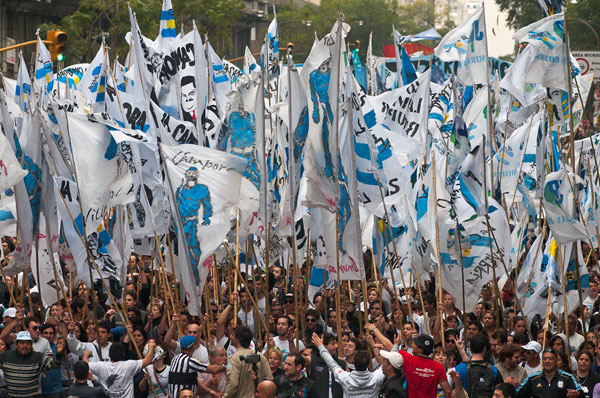
La Campora at a recent protest. (Photo: Patricio Murphy)
These include classes for 12 to 18-year-olds on Politics and Civism, Civism Construction, and Politics and Work. They are designed to encourage students’ sense of community and are articulated around projects created and managed by students as a group in what is an initiation to the mechanisms of modern democracy.
“In my school these new reforms have been extremely good, the students can choose what direction they want to take with their projects and have to compromise and discuss with their fellow students,” explains Canale.
Silvia Finnochio, a doctor in social sciences from the Latin American Faculty for Social Sciences, and professor in history at the Buenos Aires University who has written extensively on the place of young people and education in Argentine society, believes that young people are far from being “apathetic” as some opponents of the law have claimed. She said that they can bring a number of new elements to the public discourse and that they already have put forward new valuable perspectives on issues such as “memory and justice, the environment, and our consumerist society”.
A Question of Timing
In the current debate it is not so much the concept of extending voting rights to 16-year-olds, who can already be employed legally and are considered criminally responsible, that has been questioned by opponents of the government as the timing of the law proposal.
If the bill is approved, the new voting rights would first be used in next year’s legislative elections, in which the FPV will look to extend its dominance in congress.
Opponents of the bill see this, and not a desire to integrate the youth in politics, as the real reason behind the extension of voting rights. They point to a similar bill that was drafted by the Frente Amplio Progresista (FAP) in 2008 and was never properly considered by congress due to a lack of interest from the ruling party on the issue.
“It is a shame that such an interesting debate, that touches on what young people could bring to the political culture of our society is tainted by an inevitable sense of opportunism,” says Finnochio. In agreement is Doctor Adolfo Stubrin, from the Radical Party (UCR), head of planning at the Universidad del Litoral in Santa Fe and former president of the radical National Convention, who is “in favour of an extension of voting rights but as a part of a larger programme of inclusion and social integration”.
Optional or Compulsory?

Election Day in Buenos Aires (by Jorge Gobbi)
One of the key points of the debate between opposition and the ruling party has been the non-compulsory element of the law. According to the Argentine Constitution, voting is compulsory and sanctions exist for those who fail to do so. An exception is made for citizens over 70 years old who, although in theory are still obliged to vote, can no longer be punished for not doing so.
“The optional element of the law has been shown as an incoherence and as proof of the opportunistic and manipulative intentions behind the project. It’s like saying: we will give the rights to everyone, but the ruling party, that is able to mobilise more young women and men, will benefit more,” says Stubrin.
He also denounces “an irruption of political propaganda in secondary schools” in recent years in favour of President Fernández and her party.
These accusations were levelled last month at President Fernández after it was revealed that young activists from the pro-Kirchner youth organisation La Cámpora, led by Máximo Kirchner, the president’s son, had been holding workshops in secondary schools. The government defended these interventions as voluntary social programs designed to help the schools and Vice-President Boudou linked the opposition’s criticisms to propaganda during the 1970s in which the last military dictatorship tried to depoliticise young militants.
Constitutional Reform
Another recurrent criticism of the new law is that creating an exception by making voting optional for 16 and 17-year-olds would imply modifying, or at least bending, the constitution. This point has been raised and is particularly problematic in the eyes of political opponents of the president who fear she may try to reform the constitution to run in the next presidential elections.
“For this law to be possible you have to change the constitution and that worries me; we don’t want it to be the case that behind this move is a masked attempt for a reform that would allow the re-reelection of Cristina [Fernández de] Kirchner,” said Horacio Larreta the head of the Propuesta Republicana party (PRO) for the city of Buenos Aires.
President Fernández is currently serving her second consecutive term and is therefore forbidden by the constitution to run in the 2015 elections. She won the 2011 elections with an overwhelming majority but she is yet to designate a successor who could benefit directly from her popularity and no one obvious candidate is yet defined.
Whereas the PRO still has to announce its official position on whether to vote in favour or against the current bill, the FAP party, headed by Hermes Binner who came in second in the last presidential elections, has called to vote in favour.
However the FAP, and in particular it’s youth branch, have called for a number of amendments in the law. “Our position is that the vote should be compulsory for 16 to 18-year-olds, if not it would be discrimination against this age category and would be in clear contradiction with our constitution that says that suffrage should be ‘universal, equal, secret and compulsory’”, explained Maximiliano Diaz, head of the FAP’s Socialist Youth organisation.
Voting Rights in Latin America
Should the law be approved Argentina would not be an exception in Latin America as Brazil, Nicaragua, Ecuador and Cuba have all granted the right to vote to 16 and 17-year-olds.
Finocchio believes that in terms of granting more importance to young people in politics and society in general “it is very important that there is a balance in the region” and that “Brazil is a pioneer in this domain and has managed to do very innovative and interesting things that are unknown of, or ignored, in Argentina”.
In Brazil the constitutional reform implemented at the end of the last dictatorship in 1988 included the right to vote for 16 year-olds on an optional basis, while it is compulsory for citizens over 18. Policies of social inclusion in terms of gender, social class and youth have been banners of the two last presidencies.
The same voting rights apply in Ecuador and discussion on whether to implement similar measures are being held in Uruguay and Colombia and they were discussed and rejected in Venezuela. Nicaragua is the exception in the region as voting there is compulsory from age 16.
Argentina has followed the pattern of several of its neighbours in recent years in electing leaders running on platforms of equality and social inclusion, now it would seem that it wants to follow it’s biggest neighbour on the path of integrating younger people into its political culture. The consensus seems to be that lowering the voting age may be a step in the right direction but should serve as the first one on a longer path towards an extended democracy.
To find out what locals think about the voting reform, click here.


